2025-12-06 13:22:48
---
Walden, Found
Almost ten years ago, I left an assignment in New York and started driving around New England. No destination. No goal other than to discover things and places that were new to me.
Imagine my shock and awe when, on day two, I found Walden Pond.
This makes more sense when you realize I didn’t know it was a real place. I’d read Thoreau’s *Walden* and genuinely enjoyed it—but never understood that he had really gone someplace. A physical location. A place we can visit, too.
And so it was with exuberance that I turned down that drive marked by a simple sign that read: Walden Pond.
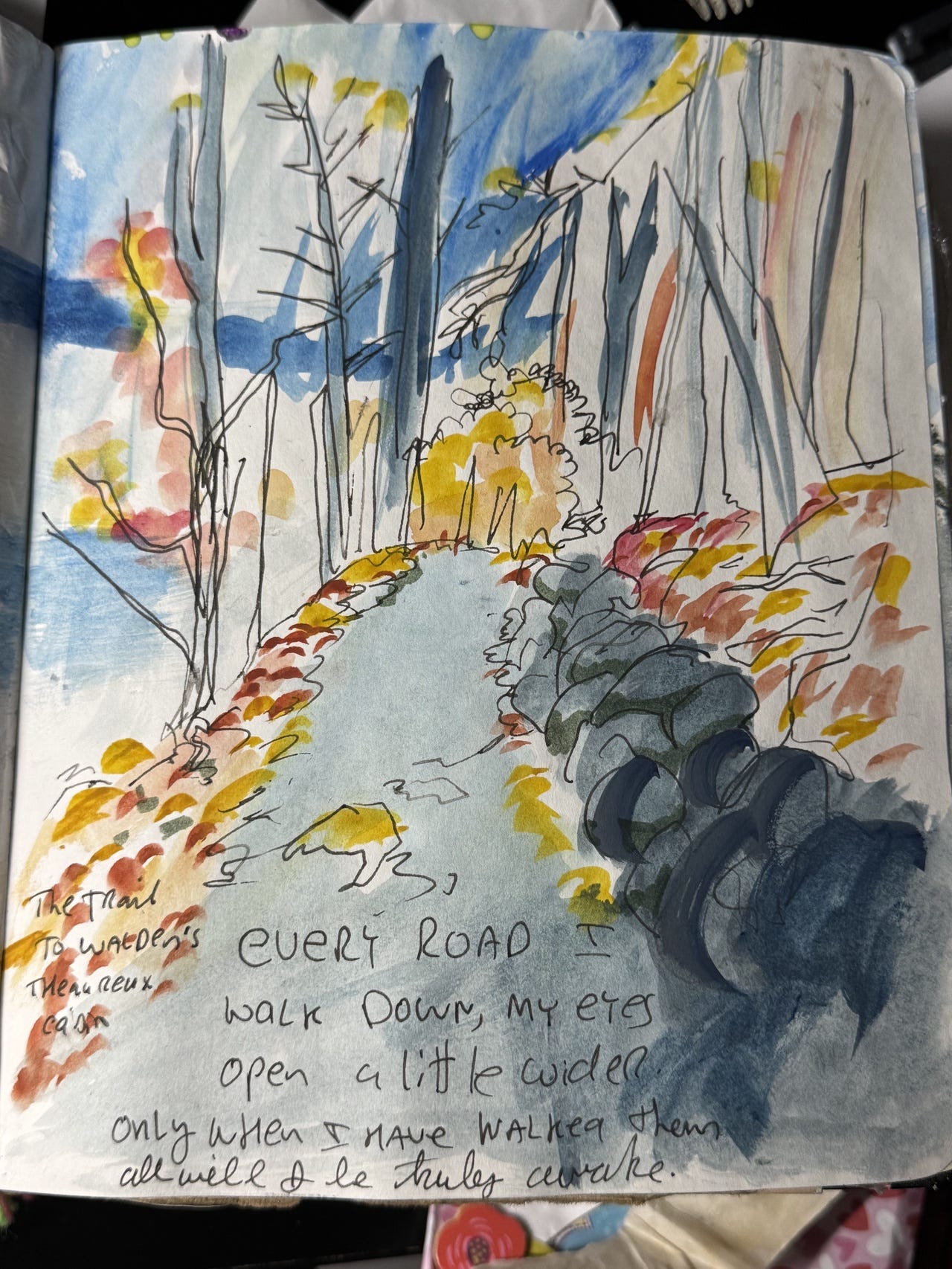
Every road I walk down, my eyes open a little wider.
Only when I have walked them all will I truly be awake
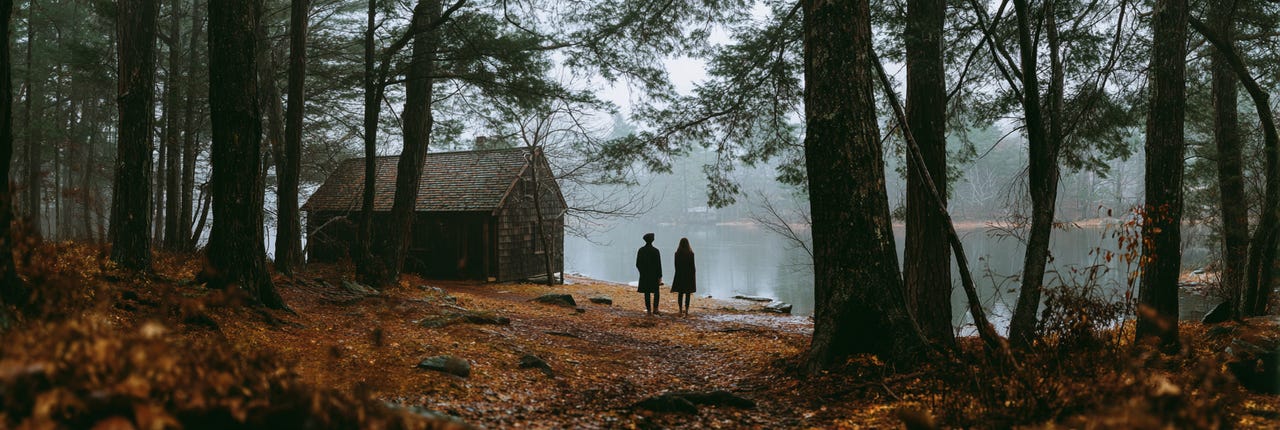
This was New England at the end of leaf season, so the trees were not quite bare—shivering their not-quite-nude bodies beneath a murky winter sky. Their golden and red glory wrapped every part of the landscape, right up to and in luscious contrast with the silky black water of the pond.
Walden is surrounded by a dense forest of red maple, pine, and several varieties of oak. The path from the entrance to the far end of the lake—where Thoreau lived his year of intention—was hilly and winding. The leaves were the perfect texture to crunch and crinkle gloriously underfoot as I trudged along.
It felt like that first reading of *The Lion, the Witch and the Wardrobe*, when Peter, Susan, Edmund, and Lucy first wander into Narnia. Every step carried me farther from the twenty-first century and deeper into the nineteenth.
Adding to the mystique, the cold, damp weather meant no other human trod the lake’s shores. Just a two souls wandering on a winter day.
Magic.
We stopped occasionally so I could gather leaves and bark to paste into the pages of my journal—and in some cases send as small gifts to friends. We took longer breaks so I could sketch rocks, trees, and little details that still linger in my mind today because I once stopped long enough to draw them.
At some point, the mist of time shrouds the reason tensions developed. I probably undersold how far the walk back to the old cabin site really was. I’ve been known to soften the truth about the effort required for these sorts of sojourns. But it could have been anything. As we walked, frustration grew, and rather than smoothing it over, we each carried our own quiet superiority.
Until we spotted the site of Thoreau’s cabin.
In that instant, the argument melted away entirely. All the negative energy was drained into some unseen, ethereal lightning rod, and we were—separately and together—smitten by the romance of standing where Henry David Thoreau composed one of the great works of the nineteenth century.
Hell, it still stands head and shoulders above most things written since.
We were suddenly *together* there. Experiencing more than just the historical reality of a once-great thinker. For me, it marked a new awareness: that *Walden*, and writing in general, had far more depth than I had ever realized. Most—if not all—good writing suddenly made sense.
It comes from somewhere real.
This gave me hope. Because I am somewhere.
Experiencing things.
Later that day, we visited the home of Louisa May Alcott. That night, a fantastic public library—one both of those writers had known, along with dozens of others.
Hallowed ground.
I will never be a great writer.
But I *am* a writer.
I *am* a poet.
An artist.
And by that measure, this life is a success.
---
### Coming From Somewhere
What Walden gave me was not permission to withdraw from the world, but permission to *locate myself within it*.
Before that day, I believed—quietly, unexamined—that writing was an act of cleverness. Or sensitivity. Or emotional acuity. Something internal and almost abstract. You felt deeply enough, thought hard enough, suffered cleanly enough, and words would follow.
Standing where Thoreau’s cabin once stood corrected that illusion.
He didn’t write *Walden* because he thought beautifully in the abstract. He wrote it because he went somewhere, stayed there, noticed things, and allowed time and place to work on him. The pond was not a metaphor first. It was cold water. Dark water. Water that reflected trees and seasons and solitude long before it reflected ideas.
That realization changed my relationship to my own work.
I stopped believing that writing was something I did only when inspiration arrived. I began to understand it as something that emerges when I place myself—deliberately—in the path of experience. Walking streets. Sitting in libraries. Watching light change on stone. Listening carefully. Staying long enough for friction, boredom, and beauty to all have their say.
I learned that my notebooks mattered. That sketches mattered. That gathering leaves, recording footsteps, wandering without agenda—these were not indulgences or distractions. They were *practice*.
Walden taught me that art does not come from escape, but from attention.
From choosing a place—any place—and meeting it honestly.
I am not a man who can disappear into the woods for two years. My life is tethered to others, to duty, to obligation, to love. But I can still claim moments of intention. I can still walk with my eyes open. I can still write from somewhere real.
I don’t need a cabin.
I need presence.
And so my work now—these missives, these poems, these recordings, these wandering essays—are my Walden. Temporary clearings where I pause long enough to notice what it means to be alive in this body, in this century, carrying this particular heart.
I write because I am somewhere.
And because I am paying attention.
---