

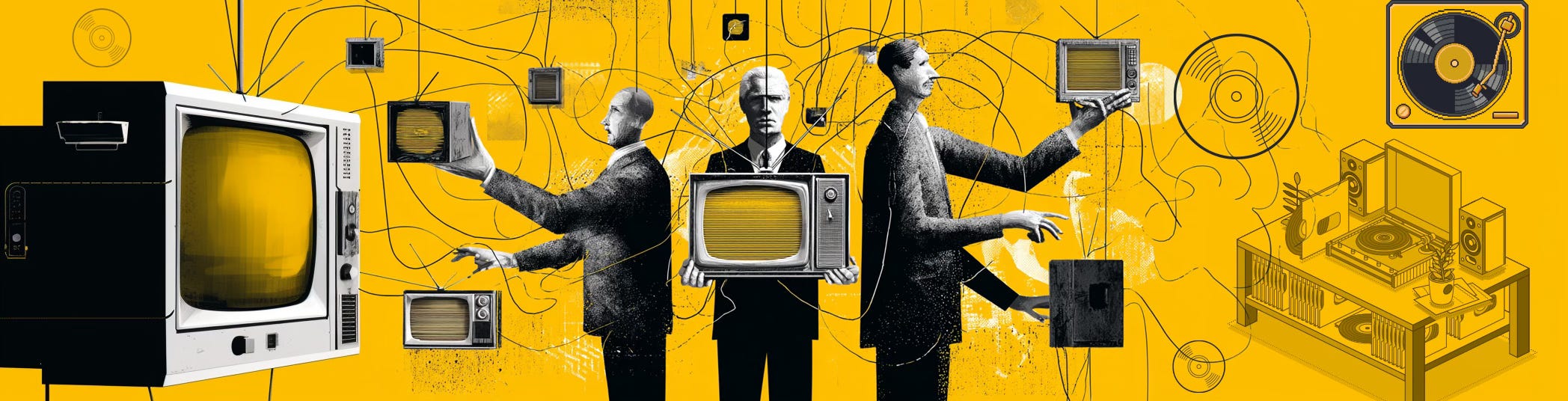
There are so many terrific and enjoyable creative minds in the world. I don’t think humanity was made to function at the intellectual or creative speed we’re asked to — and it’s mostly a request from the monied, the powerful, the technocrats. They need us more than we need them.
The Machine and the Muse

A creative mind can be just that, with nothing more than imagination, their own body, a pile of rocks, or a marking tool. But we’ve been driven to believe that for our creativity to be valid, it must be packaged, promoted, and sold. Enter social media.
What a joke. What an abomination of a joke.
In that desperation, we start looking for tools to help us make faster. But you can’t speed up creativity. It happens at the speed of thought — and it always will. Translating that spark into song, dance, prose, or paint — that’s what takes time.
No problem! Tech-bros to the rescue: here’s A.I.! It’ll solve that pesky problem of not producing fast enough by shortening the gap between idea and upload.
The Digital Demon

It started with spell-check; now it’s writing our songs, playing our music, drawing our pictures, and making our videos. We just whisper our ideas into the digital void and zap — our creation appears. Only slightly bastardized, a bit off, but still very cool looking. And if we’re honest, often better than what we might’ve done without the electric idol.
So faster and faster we go. Years became months. Months became weeks. Weeks became days, hours, minutes. Humanity is now pumping out creativity faster than we ever conceived.
The irony, the rub, the kick in the teeth: every iteration is just more repetition.
When was the last time you saw something that didn’t remind you of something else? And not in that delightful, Easter-egg sort of way — like realizing the Star Wars X-wings were modeled after WWII dogfights. I mean that nearly every “new” creative product feels like a reconstituted version of what came before.
Oh, there’s the occasional spark. But mostly, we’re just retreading the same vehicles forged in the first three-quarters of the 20th century.
That’s all been said before. Ironic, I know.
In Praise of Simple

That rambling preamble is to comment on the delight of minds like Austin Kleon.
He’s written a clutch of books like Show Your Work!, Steal Like an Artist, and the one that put him on the map, Newspaper Blackout.
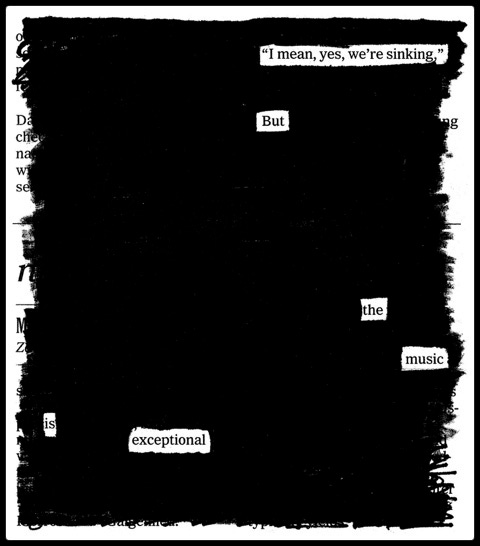
The thing Mr. Kleon nailed was simplicity. He was ahead of the “people-don’t-read-anymore” curve, and his reconstituted work felt like something anyone could do.
Newspaper Blackout, in particular, felt achievable. I tried it. Anyone cannot.
And that’s the point of this semi-screed: the simple stuff is the hardest — but it’s also what we enjoy most. The simple lyric that lands just right (“I love you” rising to a crescendo). The simple image (a banana taped to a wall). Like Miles Davis said, it’s not the notes — it’s the space between them.
It’s where this artist is trying to live. But it’s hard. Knowing what to leave out just isn’t a natural thing, not for most of us.