

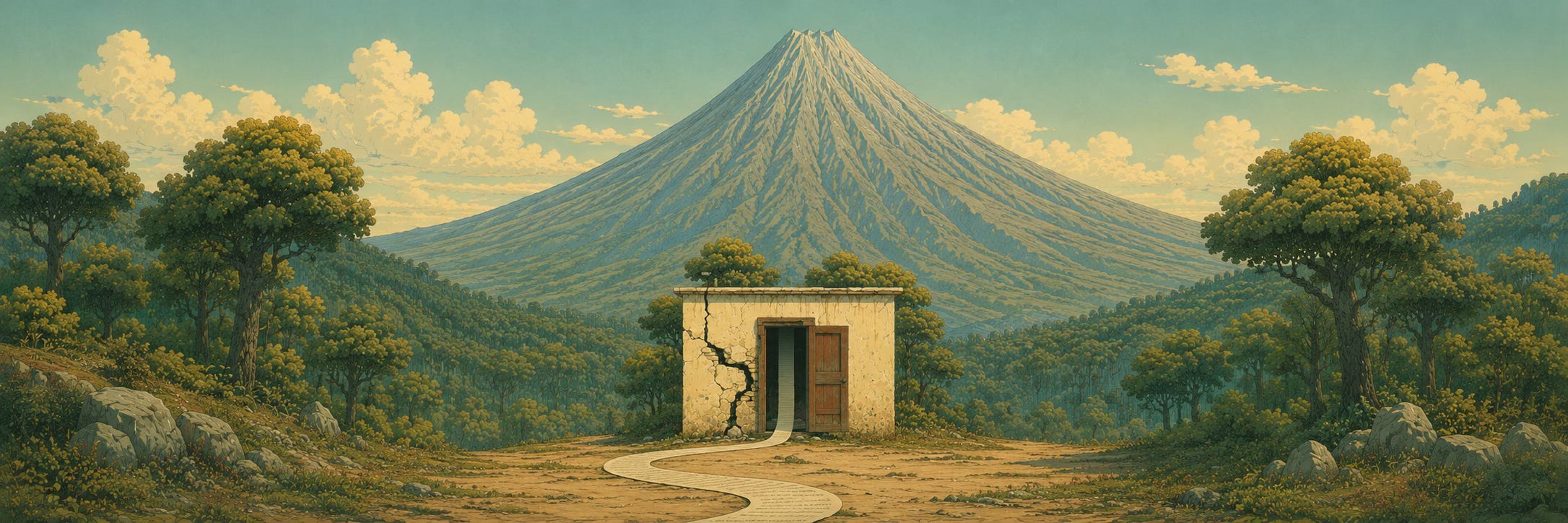
A sleeping mountain
stood watch over an old
village.

At the edge stood a small stone house
where a watcher gathered records
of ordinary days:

rainfall,
market,
broken cartwheels,
the first figs of summer,
names of children
making young life,
names of elders
who had forgotten
their own.

Faces coming and going.

He wrote them all
in a book of gray paper
and hid the book
inside the wall.

Not because it was evil.

Because it was alive.

And living things,
when handled without mercy,
can be mistaken
for crimes.

So the watcher kept and and worked
in service to the greater goods.

He mended gates.
Carried water.
Walked miles in bad weather.
Sat beside the sick.
Made bread appear
when cupboards had become
a kind of prayer.

He dug the ditches and
No one called this strange.
Kindness is only suspicious
after a fire.

There was also a flame
in the village.

Not a fire for cooking,
not a torch for roads,
not a candle for the dead.

A flame.

The keeper saw it
and knew at once
that it could warm him
or ruin him.

So he built glass around it.

He did not touch it.
He did not claim it.
He did not carry it away
under his cloak.

Sometimes he watched it burn
from the safe side of the glass.
Comfortable in restraint.

So long, even the
Flame forgot
It was alive and dangerous.

It was possibly hubris. Carelessness.
Some might say cowardice.

He called it hunger
buried alive.

He called it the long religion
of not touching
the thing that burns.

One day,
a young witness
found is record he thought so forgotten.

When opening its stone-colored pages
expecting dust,

it danced and breathed and brewed storm clouds.

The ink rose up,
Margins filled with blood.
The old weather became evidence.
Former kindness transformed into motive.

Every loaf,
every mile,
every hand extended
was dragged beneath candle smoke
and ordered to confess.

The witness did not read
as a child reads a secret.

She read as a giant
crossing a city,

and with every step
some little roof gave way.

The village gathered.

The book was placed
in the square.

The keeper stood
in a bright court
of young anger.

Under law.

Someone invoked the article of the destroyed:

Betrayal.

A word with mud on its boots.
A word that wants no face.
A word that makes one soul porcelain
and another filth.

As if longing
were a rope.

As if restraint
were rehearsal.

As if love were clean
only when the village
had licensed the fire.

Then the mountain woke.

Not all at once.

First, the birds left.
Then the wells tasted of metal.
Then become dried skin,
old roads split.

By evening, ash had entered
every open window.

It settled on cradles.
On marriage beds.
On ledgers,
libraries.
and bread
cooling beside the stove.

Eruptions are not selective.

Everything burns equally.

Afterward,
the village needed one villain
large enough
to hold the terror.

It needed one name
to carry all the smoke.

The keeper would do.

So they changed the past.

The feast became bait.
The shelter became strategy.
The tenderness became a hook.
The years became a corridor
leading only to the fire.

Even the children’s laughter
suddenly sounded like
pied manipulation.

Life and danger hidden
May poison the present
But do not let it counterfeit the past.

The river had still been a river.

The bread had still been bread.

The road walked in rain
Was still wet dirt in spring.

Monsters sometimes appear in shadows.
When they are just men in bad light.

There is a difference.

No defense could enter the square
without sounding like pleading.

No apology could cross it
without sounding like a trick.

No explanation could survive
while hammers was still swinging.

So the book was closed.

The flame was guarded.
The witness was guarded.
The house was guarded.
The name of the village
was guarded.

God, maybe,
guarded the silence.

And the keeper stood
outside it all,

holding the match,
holding the wound,
holding the years
that had been real

even as the paint
peeled from them.

Let the young reader hate him
with the clean bright hate
of someone whose playrooms
have just made
a terrible sound.

Let the village call him
what villages call the man
standing nearest the crater.

But somewhere beneath the ash
there remained this:

He was not lying.

He was sometimes failing.

There is a difference.

And God help every village
that forgets the difference

between a man
and a monster.

—

Years later,
when grass returned
to the black slopes,

someone found a page
the fire had failed to eat.

It did not excuse him.

It did not condemn him.

It only said:

The flame was real.
The glass was real.
The hunger was real.
The restraint was real.

And so was the bread.