

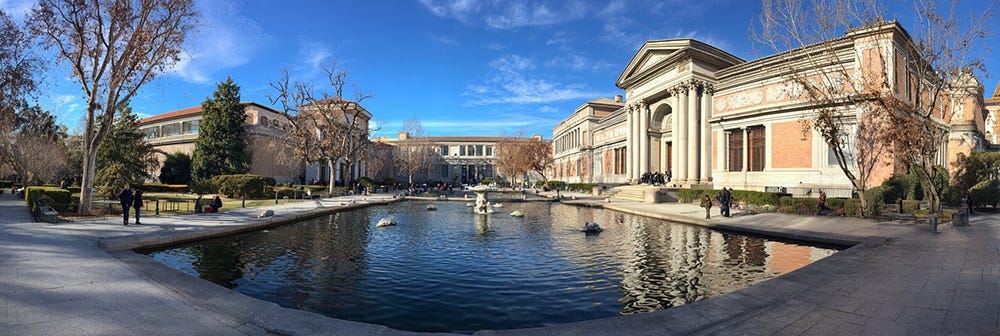
If you skip one of these, this would be a good candidate. It was kind of a mess. I never quite got real traction, being interrupted by other patrons, or security. Honestly, I’m not even sure what I captured.
Before we even got inside, there was a cat.
His name, apparently, was Magnificiencia. Or maybe Magnificent. Either way, he had earned it. He was a nice cat, with a checkered little pattern and a pretty collar someone’s mother had made. Handmade, of course. Which immediately led to the obvious conclusion that we should learn how to knit.
Yes, we should learn how to knit.
Would I make fun of someone for knitting? Obviously not. You see me making fun of knitters all the time? Exactly.
Getting into the Prado, though, was like getting on a plane. There were scanners, bags, coats, people waiting, people not waiting, hands freezing, and the general feeling that civilization had become one long line of small procedures. I saw why they had a “friends” entrance on the other side. Friends, apparently, probably didn’t have to go through all that rigmarole.
We were trying to get everything sorted — bags, coats, olives, snacks, whatever else we had apparently brought into one of the most important museums in the world. I had food in my bag because we had gone grocery shopping first, which all of a sudden wasn’t the forward-thinking decision f a hungry human, but a crime. :-/ There were lockers. There was confusion. There was: off with the jackets. Jelly was being swept through. Someone else was worried about dogs. At one point I asked if there was room for my coat with the olives.
There was not.
“What kind of big-brother operation is this?” I asked, which seemed like a fair question.
Eventually, after much shuffling and a certain amount of domestic comedy, we made it in.
Hello, new field report from the Prado Museum.
Getting in there really was as bad as getting on an airplane. It was mid-afternoon, around four o’clock, and the place was already packed. There were people everywhere. Beautiful people, tired people, tourists, guards, couples, families, and museum-goers drifting around in that half-reverent, half-bewildered way people do when they know they are supposed to be impressed but have not yet found the correct object at which to aim their awe.
Someone said they were going to see if they recognized Jesus.
“It’s way too swanky to be Jesus,” I said. “Sorry. There’s no way.”
I got why they would think that, but no chance.
Then, naturally, there he was.
The Dead Christ.
It was a nice sculpture. A little thin, maybe, but the details were cool — the hands, the feet, the penetration marks. The toes, though, were humongous. Virtually prehensile. SOMEONE has a foot thing.
Nearby was a girl in pink, not JUST pink, the prettiest pink in the world. Eduardo Rosales’ portrait of Concepción Serrano y Domínguez, daughter of General Francisco Serrano, at the age of eleven. The fabric was wonderful. She must have been a very nice woman at eleven years old, if such a thing can be said about a painted child in a museum.
Came The Death of Lucrezia, and then The Allegory of Dance.
My attention was held.
A graceful young woman was depicted nude, playing the tambourine, encircled by mischievous children dancing around her. The description said it was especially virtuosic in technique, a decorative sculpture based on models by an artist known for idealized nudes. It was luminous. Like marble doing something marble should not be able to do.
Very nice.
Then there was The Pearl and the Wave, acclaimed at the 1863 Paris Salon during the French Second Empire. The artist, it seemed, was drawn to naked ladies. Although, to be fair, the stern-looking man in a beard nearby was not nearly as interesting as the woman lying in the waves with her milky skin.
The human form wins every time.
There were studies too, and I liked those. The working-out of a thing before the thing. The effort behind the effort. In museums, I often like the studies as much as the finished pieces because they let you see the painter thinking. The polish is gone, but the mind is still visible.
Then we reached Rosa Bonheur’s Lions and Lionesses, and I tried to take a picture.
No photos.
A guard appeared immediately. No photos. Not in the hall, not in the museum rooms, not in the first story, not in the studies. No photos.
I asked why, partly because I was curious and partly because different museums have different reasons. At the Sistine Chapel, they say no photos, and when you ask why, the answer is basically, “Because we own it.” Copyright, control, the holiness of commerce.
But at the Prado, the answer was better, reasobable. The quality of the visit changes when people are taking photos. It slows everything down. It becomes dangerous for the people who came for the experience. Everyone is looking through a phone instead of looking.
That made sense.
The guard also said the paintings were available on the museum website and could be downloaded for free.
Public domain. Imagine that. Civilization occasionally works.
Aalso, because if everyone photographed every painting in the Prado, no one would ever move again.
The lion had a varnish on it, which explained the shine. It was a big lion face, beautiful and commanding. Looking at it, someone said they should just paint lions for the rest of their life.
They should.
They could become an expert lion painter.
Then came a poor old man who had apparently been painted three times and looked terrible in all three. Nude Old Man in the Sun. He did not look ancient exactly, just thin. After a certain age, the body starts to give up its architecture. Muscle goes. Volume goes. You do not necessarily look old at first. You just begin to look less defended.
The Prado is full of enormous paintings. Queen Maria Christina and her daughter Isabella. Frames so large they were artworks in themselves. These paintings could not go anywhere except a museum. No normal wall could hold them. There were royal figures in the foreground and men on the other side of a hill shooting each other, because history, apparently, is often a formal portrait in front of an active catastrophe.
The First Carlist War. Royal solemnity arranged in harmonious composition while armies skirmished in the background.
That is politics, I suppose: someone in silk, someone in mud, everyone pretending it makes sense.
Then came Fortuny. More naked ladies. I liked how the museum contrasted the naked ladies with the boring politician paintings. It was probably not intentional, but it worked. Flesh, marble, fabric, empire, generals, Venus, war. The whole human circus, hung wall to wall.
One painting looked like Mark Antony and Cleopatra, but it was not. It was Aeneas Telling Dido the Misfortunes of Troy. Or, as I first read it, Anus Telling Dido the Misfortunes of Troy.
Aeneas. Not anus.
Very different guy.
Nearby, Aeneas became a god. Venus anointed him with divine perfume, touching his mouth with a mixture of ambrosia and nectar, transforming him into something immortal. The label explained that this came from Ovid’s Metamorphoses. After ordering a river to wash away all the mortal aspects of Aeneas, Venus anointed him and elevated him.
I wondered whether the clouds had been painted later to obscure his genitals.
“High quality H2O,” someone said.
Exactly.
Vicki Vallencourt approved.
Then came Hebe, in marble and metal. She looked young, her top rolled down around her waist, the sculpted fabric impossibly translucent. I love when sculptors do that. How do you make stone look like sheer fabric? How do you persuade marble to behave like breath?
It was not the most masterful thing in the museum, maybe, but it had that magic. The body visible through material that should not reveal it. Stone pretending to be cloth pretending to conceal skin.
There were also preparatory sketches for ceilings, full-on paintings made just to solve the problem of a larger painting. I liked that. It was smart to work out the details small. The Prado has a lot of studies, a lot of process, a lot of evidence that the masterpieces did not simply appear. Someone worked them out. Someone made mistakes at a manageable scale.
Then Apollo appeared, inspired by music, holding a lyre in an elegant contrapposto pose. Very naked. I was surprised by how uncovered some of the sculptures were. In many places, later generations came along and covered things. Here, Spain seemed a little looser. Or at least less committed to retroactive marble modesty.
The amount of art was almost absurd. Everywhere you turned, there were galleries stuffed with paintings. No empty walls anywhere. I am used to museums where a painting gets an entire wall so it can breathe, so it can announce itself as significant. At the Prado, there is so much work that they seem to have shrugged and said, “Hang it everywhere.”
Then there was The Birth of Venus by Antonio María Esquivel, 1842. Not the famous Venus rising from the waves, but another one. She was beautiful. Venus is always painted beautifully. She had chubby feet and no toenail polish, but she was Venus, and Venus is allowed.
Right next to her was a drunken brawl.
Inebriation.
I had been inebriation the night before. I remembered having missed most of what someone had said to me, which was odd because apparently I had said plenty myself. How can a person say a thousand things and not comprehend what is being said back? I had not been talking at someone, exactly. I had been talking to them. But maybe I had also been feeling sorry for myself.
I did not know why.
Museums have a way of doing that. You look at Venus, then war, then kings, then dead Christ, then a lion, then a nude old man in the sun, and suddenly your own interior life starts leaking into the galleries. You arrive to look at art, but the art looks back. Not in a mystical way, necessarily. More in the way a mirror looks back when you were hoping for a window.
A young fellow in one painting looked like a very handsome woman, which reminded me of a friend who wanted to be a portrait painter. He wanted to paint presidential portraits, so he went the route of serious training and got very good at it. He painted the sort of life-size, six-foot portraits that look like they belong in places where people speak quietly and wear uncomfortable shoes.
That is the thing about the Prado. It exhausts you with abundance. You cannot possibly take it all in. You can only ricochet from object to object, half-learning, half-joking, half-overwhelmed, trying to keep some little thread of attention alive while the museum keeps throwing the entire history of Western ambition at your face.
By the end, I understood why they did not want people taking pictures. Not just because it slowed down the tour. Not just because the paintings were available online. Because the point was not possession. The point was standing there, in the room, letting the scale of human effort embarrass you a little.
The Prado was too much.
Which is exactly what a world-class museum should be.